
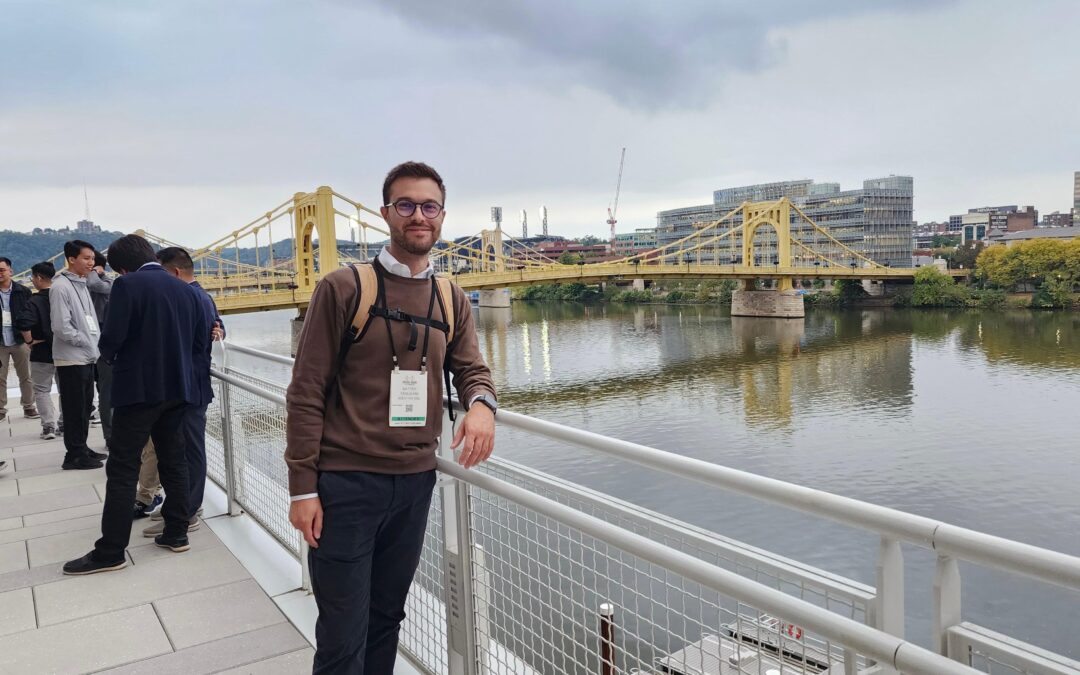
IDEATIVA at IROS 2026: Research Presented in Pittsburgh
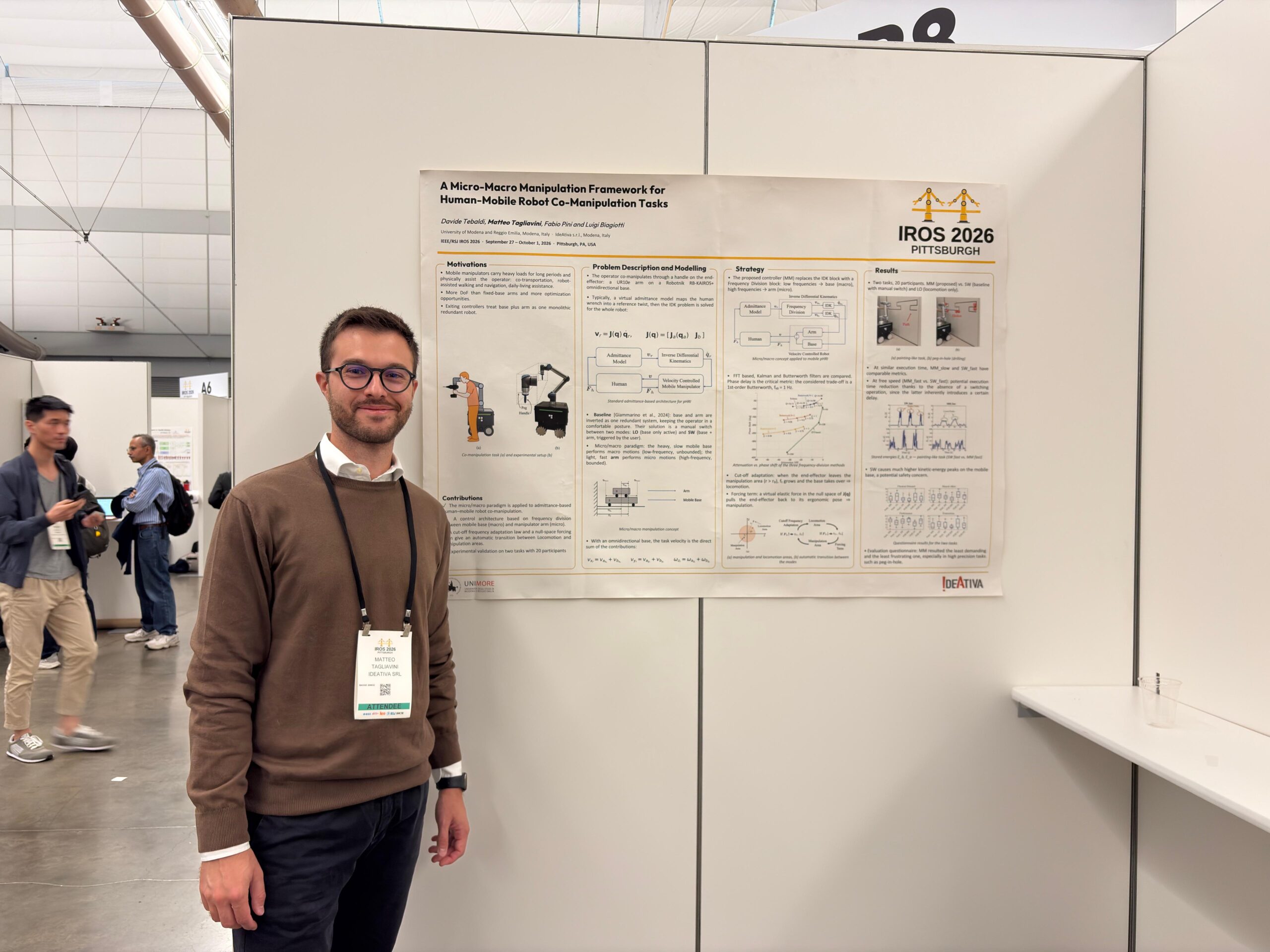
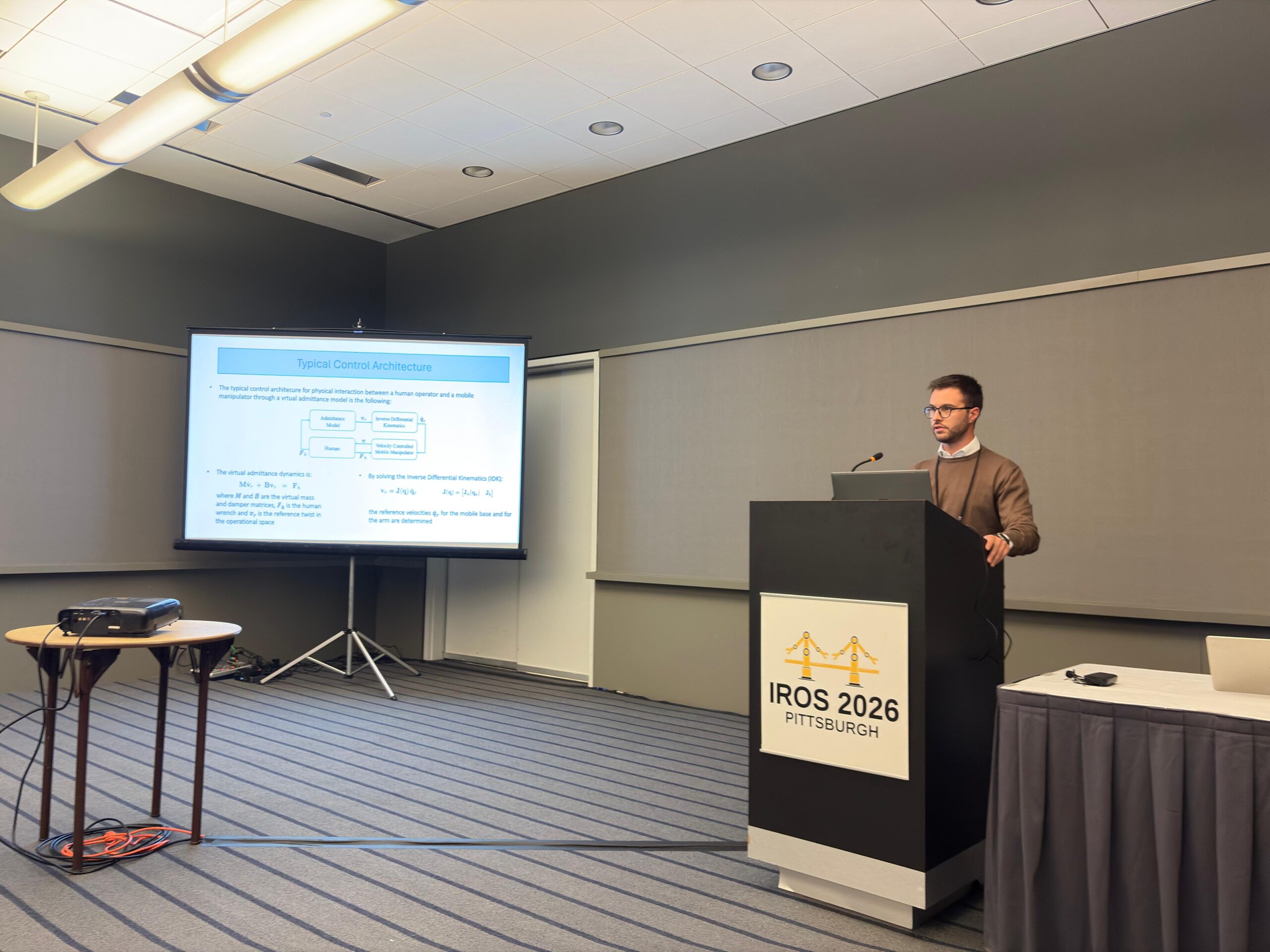
From September 27 to October 1, 2026, Pittsburgh hosted IROS 2026, the IEEE/RSJ International Conference on Intelligent Robots and Systems, one of the leading international events dedicated to robotics and intelligent systems. During the conference, Matteo Tagliavini from IDEATIVA presented the paper “A Micro-Macro Manipulation Framework for Human-Mobile Robot Co-Manipulation Tasks”, both in an oral presentation and a poster session, providing two opportunities to engage with the scientific community.
The research stems from the collaboration between IDEATIVA and the Department of Engineering “Enzo Ferrari” at the University of Modena and Reggio Emilia (UNIMORE) and focuses on physical human-robot interaction (pHRI), a field where academic research and industrial applications meet.
The Challenge: Coordinating Movement and Precision Without Manual Switching
Imagine a mobile robot equipped with a robotic arm assisting an operator in transporting heavy loads or performing precision tasks, such as drilling. In this scenario, the operator does not use a joystick or remote control but guides the robot directly by hand, pushing and orienting the tool mounted on the arm while the system interprets the applied force and moves accordingly.
The challenge arises because, in many conventional solutions, the mobile base and robotic arm are controlled as a single system. However, the robot must perform two very different functions: moving through space to reach the work area and, once there, operating with precision. Switching between these modes typically requires a manual switch, forcing the operator to decide when to change modes and divert attention from the task, potentially causing delays and frustration.
The Micro/Macro Paradigm: How It Works
To overcome this limitation, the research team applied the micro/macro paradigm to mobile robots, taking advantage of the complementary characteristics of the system’s two components. The mobile base is heavy and slow but can travel over long distances, while the robotic arm is lightweight and fast but has a limited workspace. It therefore makes sense to assign large, low-frequency movements to the base and fine, high-frequency movements to the arm.
In practice, the motion command provided by the operator through physical interaction is divided by frequency between the two components: low-frequency motion components are assigned to the base, while high-frequency components are assigned to the arm. The system also includes two additional elements: a cut-off frequency adaptation law, which adjusts motion distribution when the operator requests higher velocities, and a forcing term that brings the arm back towards an ergonomic configuration.
Thanks to these mechanisms, the transition between mobile base locomotion and precise arm movements occurs automatically. When the operator pushes firmly, the base moves to cover the required distance. When the operator slows down to perform a precision task, fine movements are handled by the arm, without the need for any manual switch.
Experimental Validation with 20 Participants
To evaluate the proposed approach, the system was tested on a real robotic platform consisting of a UR10e collaborative robot mounted on a Robotnik RB-KAIROS+ omnidirectional mobile base. Twenty participants performed two tasks: a painting-like task, in which the tool had to follow a predefined path, and a precision insertion task, requiring a peg to be inserted into a series of holes to simulate drilling.
The proposed method was compared with two reference configurations: locomotion-only mode and manual switching between precise arm manipulation and mobile base locomotion. During the experiments, both quantitative data were collected, including the system’s kinetic energy, operator effort, execution time and final tool displacement from its starting position, and qualitative data, through a NASA-TLX-inspired questionnaire assessing physical demand, perceived performance, effort and frustration.
The Results: Usability, Frustration and Safety
Participants rated the micro/macro approach more positively than the other two configurations in terms of physical demand, perceived performance, effort and frustration, particularly during the precision task, which was also the most demanding for the operator.
With manual switching, deciding when to change modes proved challenging: two out of twenty participants were unable to complete the precision insertion task because they did not identify the appropriate moment to switch.
The quantitative results point in the same direction: when working as quickly as possible, eliminating manual switching delays reduced execution time by more than 22% compared with manual switching. Furthermore, the micro/macro approach avoids the kinetic energy peaks on the mobile base produced by manual switching at higher velocities, an important consideration for the safety of people working alongside the robot.
The Collaboration Between IDEATIVA and UNIMORE
 The research was authored by Davide Tebaldi, Fabio Pini and Luigi Biagiotti from the University of Modena and Reggio Emilia, together with Matteo Tagliavini from IDEATIVA. It provides a concrete example of how collaboration between academia and industry can address real-world challenges, with the aim of making physical human-robot collaboration more natural, safer and more intuitive.
The presentation at IROS provided an opportunity to exchange ideas with the international scientific community. The research is ongoing: the next steps include a more in-depth stability analysis and extending the framework to new tasks and applications.
To learn more about the research or discuss applications and future developments in physical human-robot interaction, contact IDEATIVA.