
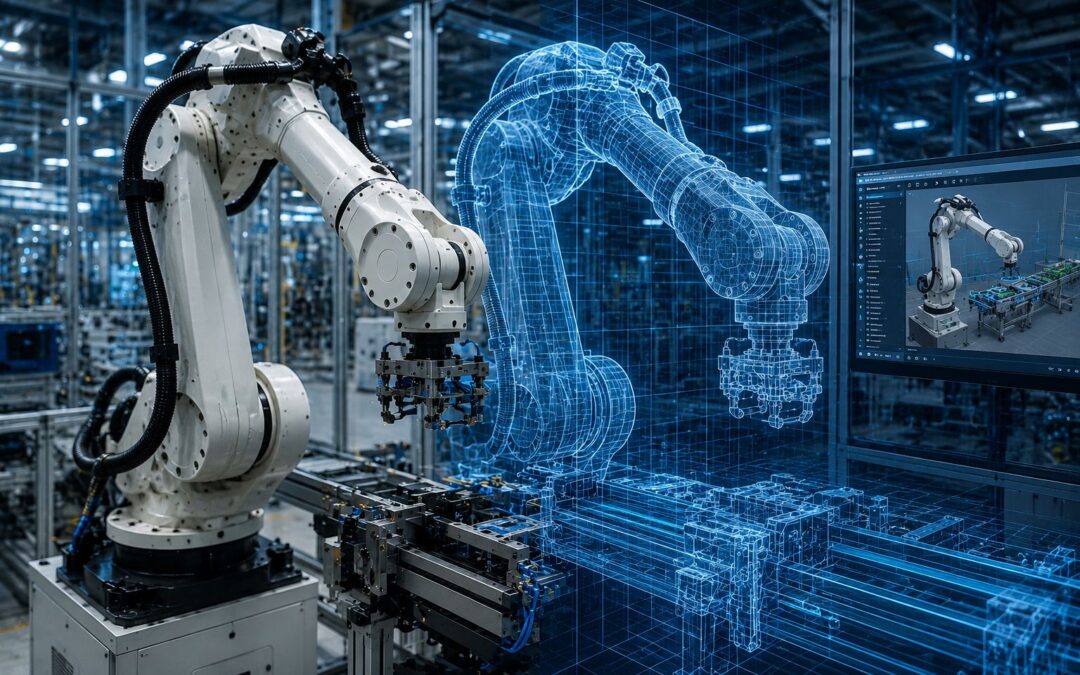
Before a robot actually enters production, a significant part of the work can take place in a virtual environment.
Simulation makes it possible to design and verify a robotic solution before its physical implementation, addressing configurations, paths and system operation in advance.
With a digital twin, however, the relationship between the virtual world and the production process becomes even more interesting.
A digital twin creates a virtual representation of a robotic system that can support different stages of a project: from design and simulation to comparison with what actually happens on the production floor.
What is a digital twin in robotics?
A digital twin is a virtual representation of a real system.
In robotics, it allows teams to work on a robotic system digitally and verify its behaviour before commissioning.
Simulation and offline programming software such as ABB RobotStudio® can be used, for example, to plan new robotic installations or adapt existing ones to new production tasks.
According to ABB, RobotStudio provides a 99% match between the robot’s digital twin and its real-world implementation and can reduce design and commissioning times by up to 50%. These figures are reported by ABB for its own solution.
The value of simulation therefore lies in the ability to bring forward some of the activities that would otherwise need to be carried out directly on the equipment.
From simulation to the real production process
Simulation does not necessarily have to be separate from production.
The transition can be understood as a sequence:
design → simulate → validate → implement → monitor → improve
Before installation, the virtual model enables teams to work on the design and verify how it behaves.
Once the system enters production, data collected from the equipment makes it possible to observe what happens during operation.
Integrating these two levels makes the use of digital twins particularly valuable in robotics: the virtual and real worlds can become parts of the same design and improvement process.
A real-world application in the biomedical sector
An example of this integration is a project developed by IDEATIVA in the Mirandola biomedical district for the assembly of components used in oncological infusion systems.
The solution integrates:
- collaborative robots;
- a digital twin;
- tools for real-time analysis of production data.
Digital simulation makes it possible to validate the process virtually before installation, while data monitoring enables analysis of its performance during operation.
In this way, automation, simulation and production information are not treated as independent elements but as parts of an integrated system.
The project demonstrates the transition from simulation to the real process, particularly in a sector where precision, control and traceability are especially important.
Explore IDEATIVA’s biomedical project
When production data comes into play
Once the system is operational, the availability of production data opens up another level of analysis.
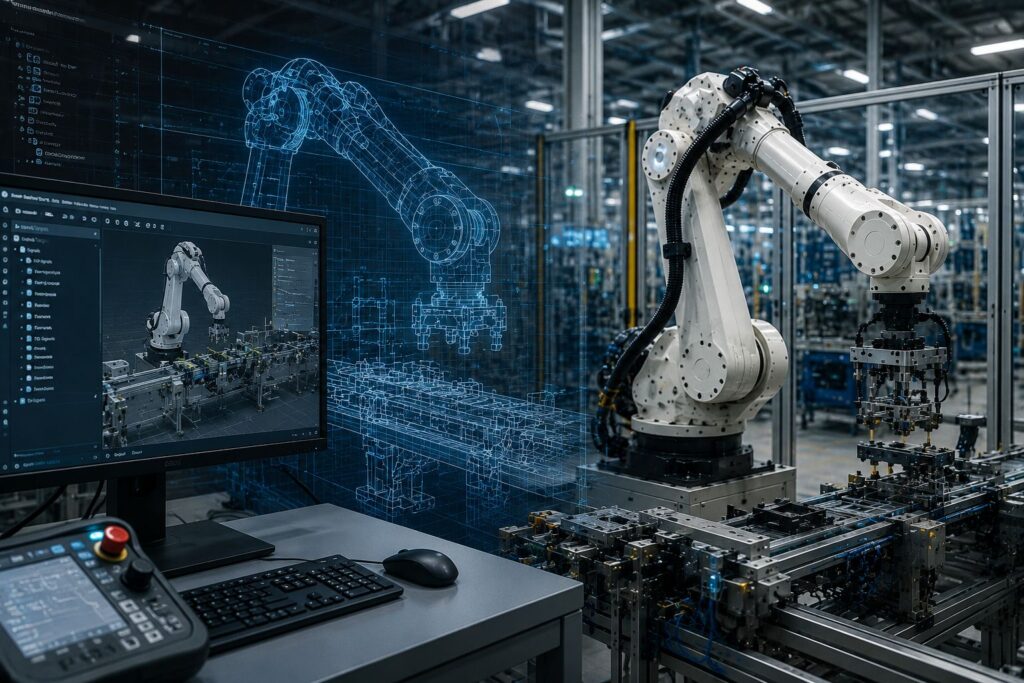
This is where platforms such as ABB OptiFact™ come in. OptiFact is designed to centrally collect, manage, visualise and analyse data from devices on the factory floor, including robots.
For example, the platform allows users to monitor performance indicators such as cycle time and OEE (Overall Equipment Effectiveness).
However, data is not only useful for describing what is happening.
ABB provides for integration between OptiFact and RobotStudio Cloud: analysing production data can help identify the causes of problems or inefficiencies, and the resulting information can be used to adjust the program and develop a better robotic solution.
This creates a relationship that does not run only from the virtual to the real world:
the real process generates information that can be fed back into the digital model to continue working on the solution.
From digital twins to process improvement
From this perspective, a digital twin is not simply a tool used before production starts.
It can become part of a broader process in which simulation, implementation and data analysis interact.
This approach makes it possible to:
- verify a solution virtually before installation;
- make changes during the design and programming stages;
- reduce the activities that need to be carried out directly on the equipment;
- connect design with real-world operation;
- use production information to identify potential areas for improvement.
Of course, the availability of digital tools does not eliminate the need to understand the production process.
On the contrary, it makes a sound analysis of the application and the desired objectives even more important.
When does robotics really make sense for a company?
An ongoing dialogue between the virtual and real worlds
Industrial robotics is becoming increasingly integrated with software, simulation systems and data analysis tools.
In this context, a digital twin can bring design and production closer together: what is developed virtually can be verified before implementation, while what happens in the real process can provide new information for analysing and improving the system.
Moving from simulation to production does not necessarily mean the end of the digital model.
When simulation, robotics and data are integrated, the virtual world and the real process can continue to interact even after commissioning.
At IDEATIVA, design, simulation and offline programming are part of an approach to robotics that begins with analysing the process and supports the development of a solution through to implementation.