

When discussing safety in robotics, attention often focuses on what happens while a system is operating: fences, sensors and emergency stops. Yet, as OSHA has also highlighted, many incidents involving robots occur during activities outside the normal production cycle, such as installation, commissioning, programming and maintenance.
These are particularly sensitive phases, when operators work close to the robot and protective measures may not yet be complete or may be temporarily bypassed.
It is precisely in this context that virtual commissioning also plays an important role in safety: it makes it possible to bring forward certain checks before the robotic cell is physically built.
Virtual commissioning: testing a cell before building it
Commissioning is the phase in which a system is installed, tested and started up. With virtual commissioning, part of these activities is brought forward into a simulation environment.
The robotic cell is recreated virtually, including robots, tools, equipment and workpieces. The model can be connected to the control systems to verify operating logic as well.
Software such as ABB RobotStudio® and FANUC ROBOGUIDE enables simulations and checks to be carried out before physical installation.
The benefits primarily concern development time and costs, but also the possibility of identifying certain operational issues in advance.
Collisions, unreachable points, incorrect sequences or impractical layouts can emerge during simulation, when changes to the design are generally simpler and do not directly expose operators to the movements of a real robot.
Safety must be designed around the entire robotic application
The safety of a robotic cell depends not only on the characteristics of the robot, but on the interaction among all the elements of the application: robot, tools, handled parts, work environment and people.
This is also a central principle of the approach taken by ISO 10218, which addresses the safety of robots and their integration within an application.
Simulation allows certain assessments to be addressed as early as the design phase, by asking practical questions:
- Where will the operator be positioned during the various activities?
- Where will the access points to the cell be located?
- How close will the operator be able to get to the robot?
- What happens in the event of unexpected movement or a stop?
- How will maintenance and workpiece recovery be managed?
These assessments help define the positioning of safeguards, slowdown and stop zones, and the space required for operator access.
ABB RobotStudio also includes a feature for simulating braking distances, which is useful for assessing robot stopping distances when designing safety zones.
The criteria for safety distances addressed by ISO 13855, as well as access requirements for maintenance and exceptional interventions, must also be considered from the earliest stages.
Collaborative robots: safety depends on the application
These assessments become particularly important with collaborative robots.
A cobot is not inherently safe: the level of safety depends on the application, the installed tool, the objects being handled and the surrounding environment.
A gripper with rounded edges presents different conditions from a pointed or sharp tool. Similarly, nearby benches, structures or other elements may create pinch points.
For this reason, choosing a collaborative robot is not enough: the entire collaborative application must be designed and assessed.
Simulation helps identify some of these issues before installation, contributing to a more informed design process.
Virtual commissioning does not replace on-site validation
Simulation supports design, but does not replace checks on the physical cell.
Safety functions must be configured and validated on the installed application. In collaborative applications, force and pressure limits also require measurements and checks under actual operating conditions.
Virtual commissioning therefore helps better prepare installation and testing activities, reducing uncertainties that might otherwise emerge during commissioning.
Virtual and physical verification are not alternatives: they are complementary stages of the same process.
From the Bologna seminar: safety starts with design
The relationship between collaborative robotics, design and safety was also central to the hands-on seminar “Collaborative robotics in research laboratories: safety, innovation and new frontiers”, organised by IDEATIVA on 21 October 2026 as part of Sìcura 2026, the University of Bologna’s safety week.
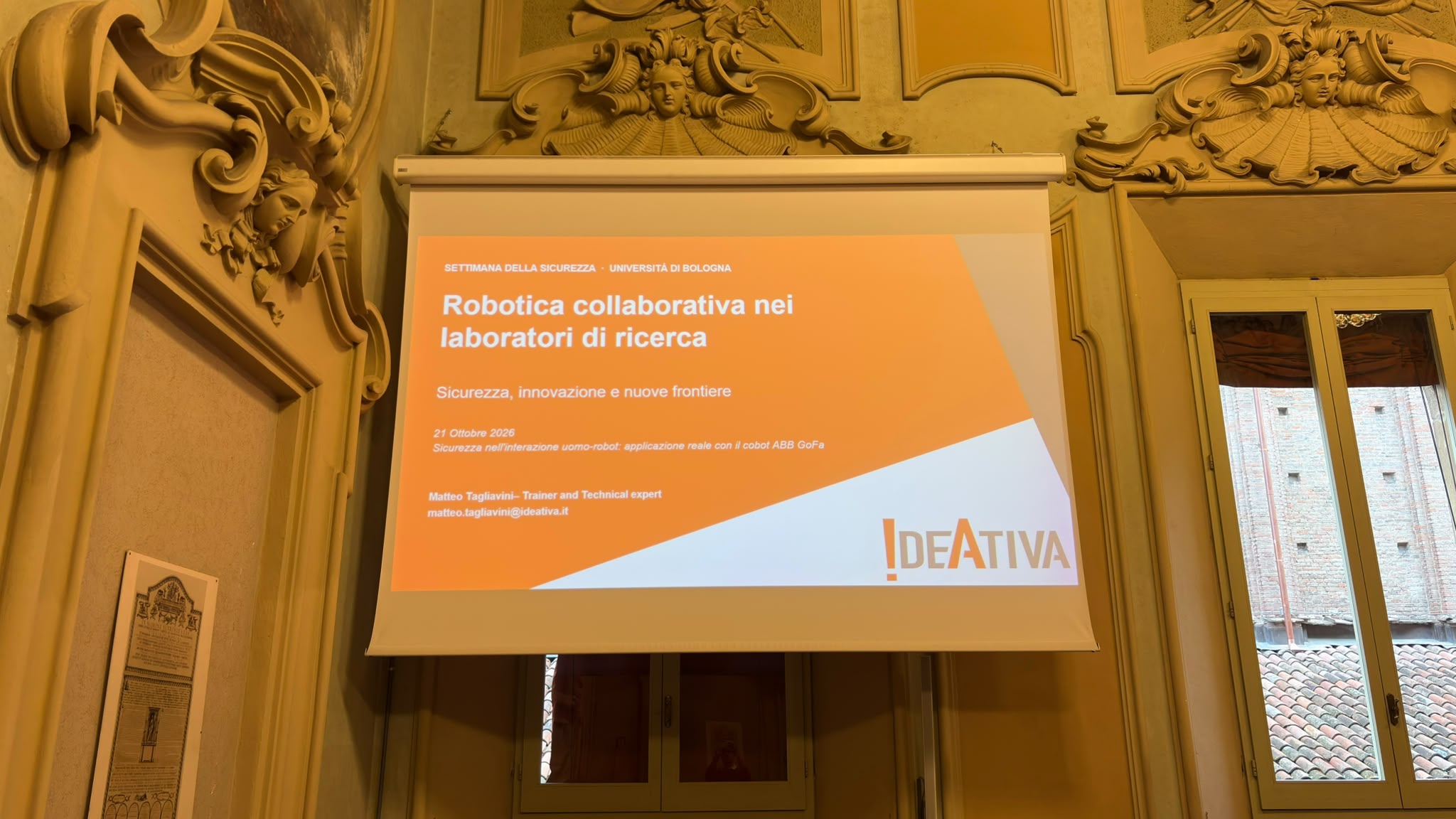

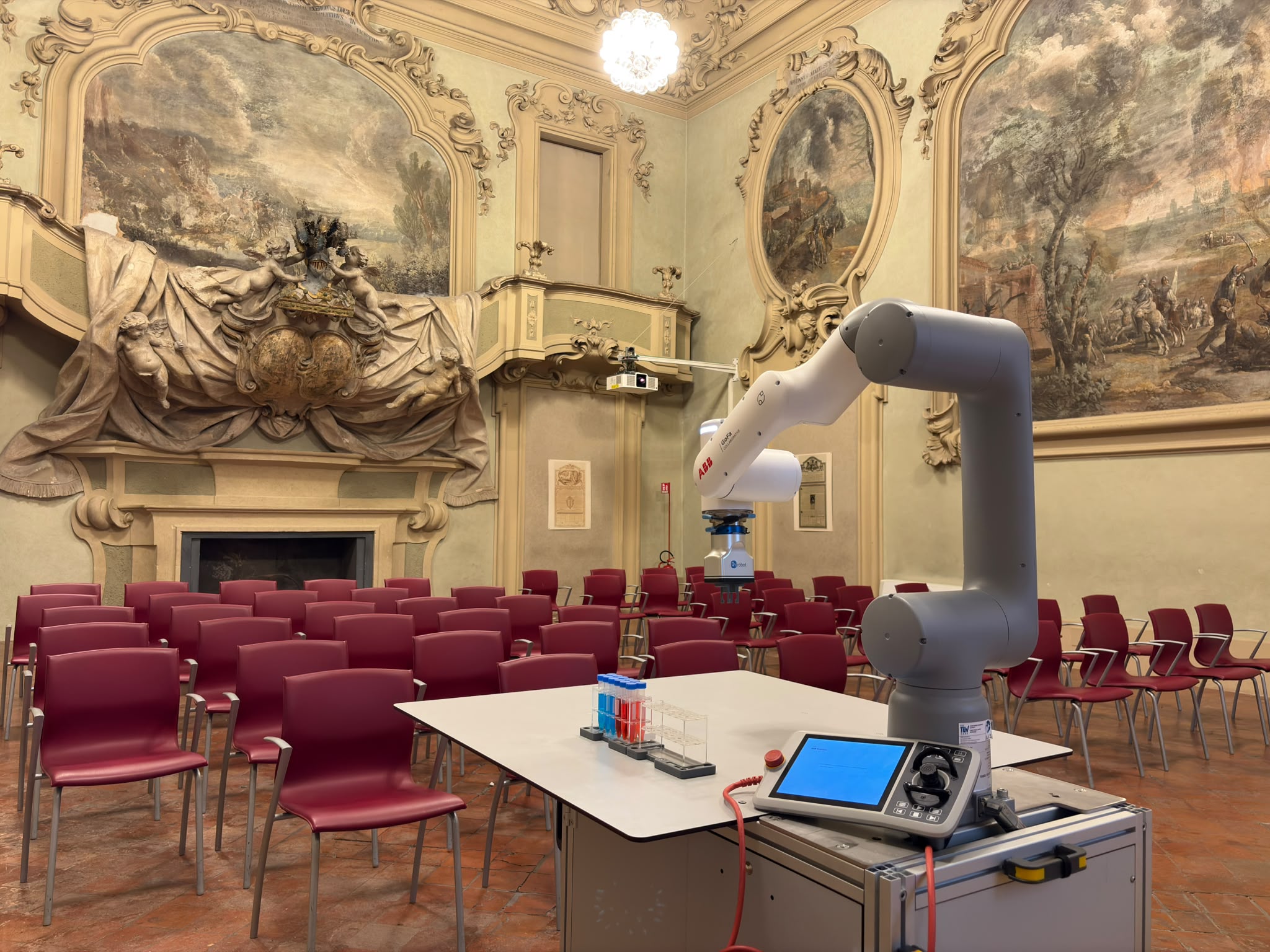
The seminar, intended for laboratory staff, the university community, professionals and the public, covered the differences between industrial and collaborative robots, regulatory references, safety devices and functions, with application examples and mistakes to avoid.
The central message was clear: there is no collaborative robot that is safe regardless of its context; there is a collaborative application that must be designed and verified.
During the practical session, using an ABB GoFa cobot, participants were able to observe different robot behaviours: from stopping during interaction to hand-guided movement, and slowing down and stopping at the boundary of a safety zone.
These demonstrations showed why speeds, forces and safety zones must be defined at the design stage and subsequently verified under real operating conditions.
Virtual commissioning fits into this process as a tool for bringing forward some checks and approaching installation and start-up with greater awareness.
From simulation to commissioning: an integrated approach
Testing a robotic cell virtually makes it possible to identify design and operational issues before it is built, limiting changes in later phases and preparing testing activities.
For IDEATIVA, offline programming, simulation and safety are interconnected aspects that begin with an analysis of the application and accompany the development of the robotic system.
The virtual model may also continue to be useful after commissioning, as discussed in our article on the Digital Twin in robotics.
To develop the skills needed to design, program and operate robotic systems, explore the training programmes offered by IdeAcademy, including customised training for companies and technical teams.