
Solutions for industrial and collaborative robotics are increasingly defined by the ability to integrate sensors and software that make robots flexible, autonomous and easy to reprogram.
In this scenario, aligning the robot’s internal reference frames with the external environment is not just a technical detail: it is the prerequisite for reliable, repeatable and safe operations.
To address this need, Ideativa has developed a kit for processing robot reference frames, currently in the Patent Pending phase.
Why define reference frames?
Industrial robots are programmed using an internal reference frame to which the tool is connected.
To perform operations within a work area, however, it is also necessary to have an auxiliary reference frame, such as the work surface of a machine, and to align it with the internal system.
Without this calibration, the tool may be out of position, with risks of collision and possible production rejects.
Existing procedures based on probes and fixed reference points require drilling machine surfaces and floors to create mounting interfaces and installing fixed points for the robot to touch. This approach can be slow to implement and not very flexible.
The limitations of traditional systems
The calibration solutions currently used have several operational limitations.
Complex mounting
The installation of fixed reference points and probes requires dedicated supports, drilling operations and wiring, increasing both time and complexity.
Inefficient repeatability
Every time the robot is moved or impacted, the entire calibration procedure must be repeated.
Safety-related aspects
The use of pointed tools and fixed reference points may require particular attention during operational activities.
Regulated environments
In sectors such as food, biomedical and pharmaceutical, the presence of wiring and dedicated supports can make surface management and cleaning activities more complex.
The kit developed by Ideativa
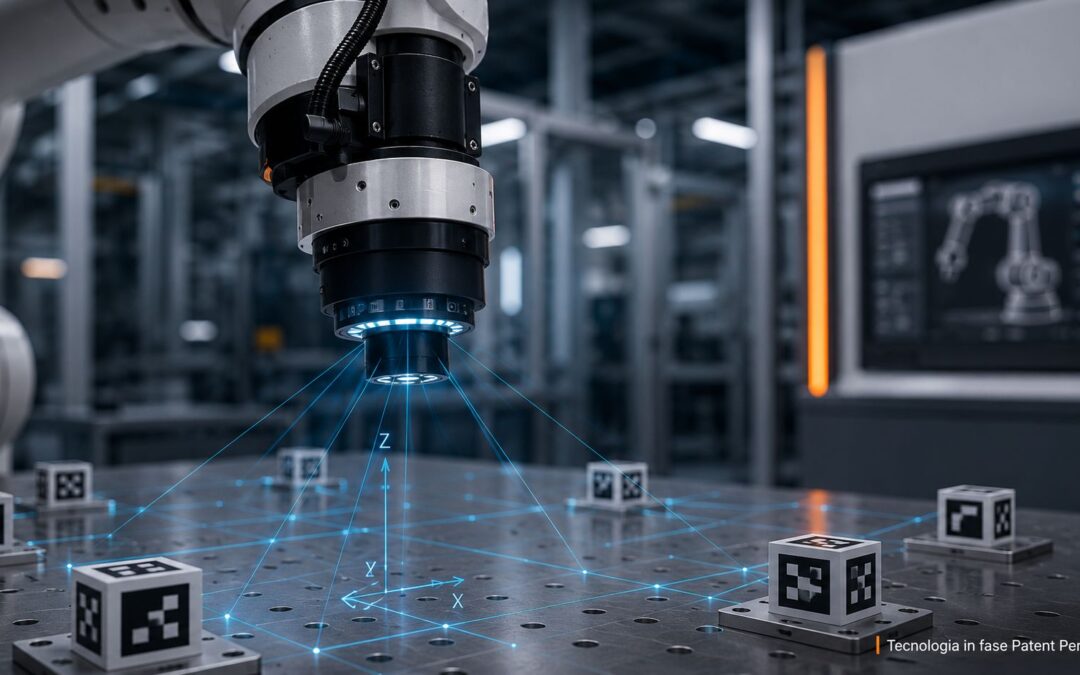
The solution designed by Ideativa consists of a working unit that can be installed on the robot or on the handling device.
The kit includes:
- a detection device capable of acquiring images of the surrounding area;
- an energy storage system required for operation;
- an electronic processing unit that analyzes the images and calculates the reference points;
- the possibility of using cloud or edge computing resources to support processing activities.
The calibration procedure is performed by acquiring images of the markers from different angles.
The system automatically processes the collected information and calculates the transformations required to align the reference frames.
This approach does not require probes, fixed reference points or complex wiring.
The advantages of the solution
One of the main advantages of the kit is its rapid installation.
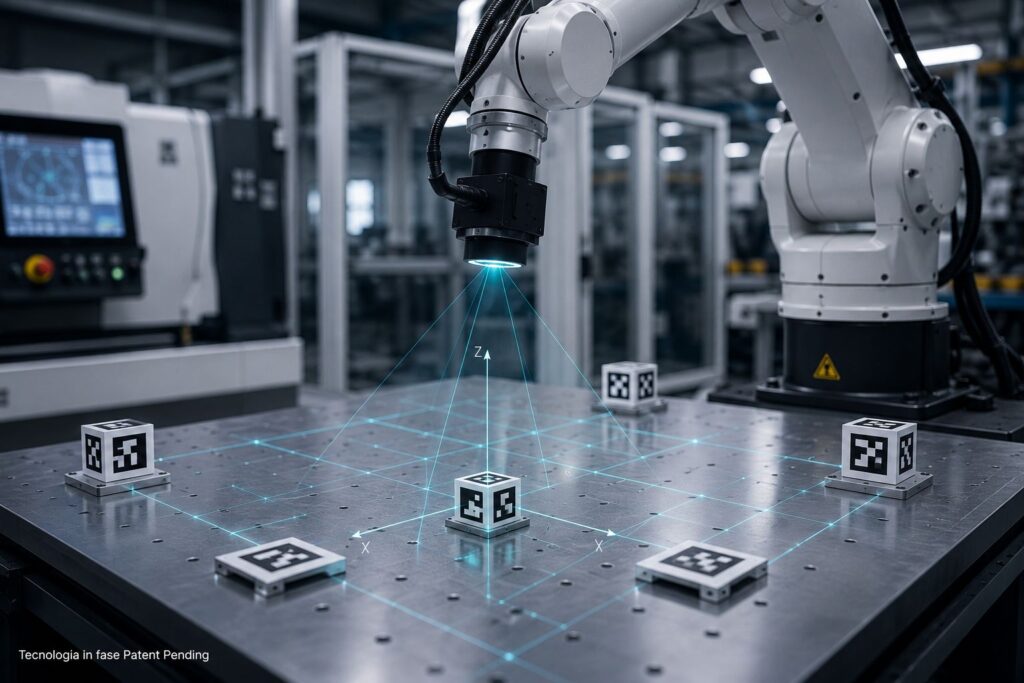
The solution can be mounted on different robots or handling devices without requiring structural modifications to the system.
Calibration and verification activities are also faster: it is sufficient to have the camera, the calibration elements and the necessary references available.
No dedicated mechanical interfaces or complex external wiring are required.
The main benefits include:
- simplified installation;
- reduced downtime;
- greater operational flexibility;
- use on different production configurations;
- local, cloud or edge processing;
- rapid verification after impacts or accidental movements.
Applications and use cases
The kit was designed for applications where robots need to be quickly realigned or operate in environments subject to specific requirements.
Assembly lines and logistics
Robotic cells can be moved and realigned without intervening on the entire system.
Food industry
Markers can be removed at the end of operations and do not permanently modify surfaces.
Biomedical and pharmaceutical sectors
The absence of wiring and dedicated mechanical elements can help simplify environment management and cleaning activities.
Patent Pending innovation
The innovation presented by Ideativa is currently in the Patent Pending phase.
Prototype development and product industrialization activities are currently underway.
For more information or to evaluate possible collaborations in the development of the solution, please contact Ideativa through its official channels.